

Landowners' Guide to Oil and Gas Wells
What is a legacy oil or gas well?
The term “legacy well” is generally used to describe a well that was drilled and abandoned historically, and for which there is no current responsible party. A portion of these wells have been located by DEP and other parties; and DEP has legal authority to properly decommission such wells, as funding levels permit. It is estimated that there are hundreds of thousands of legacy wells across the commonwealth that were abandoned without being properly decommissioned, and legacy wells are frequently discovered by landowners. An improperly abandoned well has potential health, safety, environmental, and financial concerns tied to it; so it is important for landowners to notify DEP as soon as possible following discovery and to never touch or make any modifications to any component of the well. In limited cases when a legacy well is associated with the deed of a property, a landowner might have responsibility for it; but DEP will work to ensure an equitable solution in all cases. There are also laws in the commonwealth that require reporting of legacy wells to DEP within 60 days.
To learn more, take a moment to carefully review the FAQs detailed below.
 Legacy Wells in Pennsylvania
The Abandoned and Orphan Well Plugging Program was established by the Oil and Gas Act of 1984 to address legacy wells across the commonwealth. The program investigates and tracks legacy wells identified and classifies them according to the risk they pose to the community in which they are located. Money is set aside from oil and gas well permits to fund legacy well plugging projects. Although funding levels have proven inadequate to address all wells causing environmental impacts or other concerns, available funds are used to plug wells that pose the highest risk to public health, safety and the environment.
DEP has an online mapping tool that you can use to view areas of interest. The tool allows you to view known abandoned and orphan well locations around your property and can give you an idea if your property is in an area where historical oil and gas well drilling took place. It is important to note that the majority of legacy wells will not be included in the mapping tool since they were drilled many decades prior to today’s reporting requirements and, therefore, are unknown to DEP. This tool can be useful to see if your neighborhood may have had historic oil and gas development.
Abandoned, orphan, and DEP plugged wells map
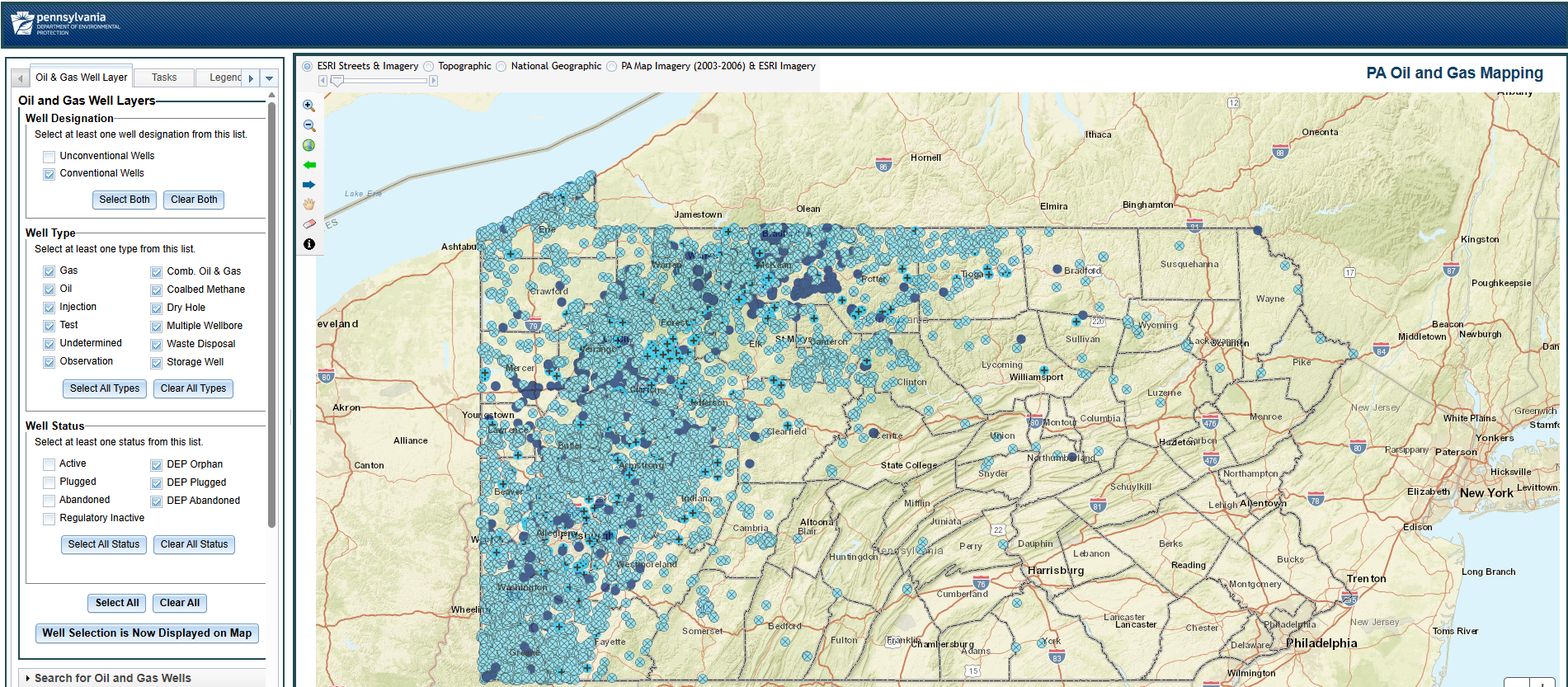
- To view abandoned, orphan, or plugged wells on the map, go to the “Oil and Gas Well Layer” tab (left side of page)
- Well Designation - select “Conventional Wells”
- Well Type – “Select All Types” button
- Well Status - select “DEP Orphan”, “DEP Abandoned”, and/or “DEP Plugged”
- Select “Submit Request” button
- Wells with the selected statuses will be displayed on the interactive map
- Select the “i” (information icon), then select any well on the map for well name, permit number, and additional information
Legacy oil or gas wells do not have a standard appearance. Sometimes wells identified by landowners are equipped with a well head and other equipment, such as piping and tanks. Many times, the well is so old that the equipment is no longer present, or it may simply appear as a rusty pipe sticking upright out of the ground. There are times someone may have intentionally buried the well below ground surface. Wells have been identified during landscaping or construction work, within foundations or basements of homes, and have been used as yard decorations. Abandoned oil and gas wells can be dangerous! If you have health and safety or environmental concerns regarding a suspected legacy well on your property, secure the area and contact your DEP District Oil and Gas Office immediately..
- A vertical rusty metal pipe sticking out of the ground
- Pooled oil accumulation
- An area of grass or other vegetation that is always dead or distressed
- Petroleum odors
- A depression or open hole in the ground where the pipe has disappeared or been removed
- Natural gas bubbling or petroleum odors in water supplied by a well or petroleum odors associated with the water well itself
Abandoned oil and gas wells can be dangerous! DO NOT attempt to modify the well in any way. Do not attempt to open any valves or turn knobs. Oil and gas wells may be isolating fluids under extremely high pressures; or may be capable of releasing explosive or toxic gases and should be considered dangerous. Do not attempt to fill in a well with soil or any other material. Do not remove or alter any piping above ground to hide it.
If an open hole is identified, prevent people from accidently encountering the hole by using blockades or other visual and/or physical deterrents. Continue to read this guide to find out what information to collect and how to make sure you do not become responsible for the well.
Prior to reporting an abandoned well, please verify that the suspected well is not already in DEP’s current inventory. Instructions for checking if the well’s existence is already known to DEP using the mapping tool can be found in the “How can I find out if there are wells on my property?” section of this page.
If no well has been inventoried in the proximity of your suspected legacy well, please report the well through DEP’s preferred method; the Report an Abandoned Well online form. Please gather the following information to report the well:
- Street address of or closest intersection to the suspected well
- If possible, coordinates while standing close to the well. (This can be obtained with a smartphone or other GPS enabled device.)
- Description of any equipment on or around the suspected well. Photos can be included with the online form or emailed at a later date.
- Description of any sounds or smells noted around the suspected well.
- Description or photos of any discharge from the well (oil, water or gas) or any dead vegetation.
After reporting the well, DEP my contact you to request additional information or pictures.
Finding a well on your property or uncovering a buried well does not make you responsible for the well, however, attempts to produce the well, receive economic benefit, improperly rid your property of any evidence of the well, or other careless activities can make you financially responsible for the well. For your safety, it is important that a DEP oil and gas representative evaluate the well and attempt to determine if a responsible company or individual exists. If a responsible party exists, they will legally be required to properly decommission the well or bring it into compliance through some other action.
Although rules vary by location, buying a parcel of land that has legacy oil and gas wells on it generally does not mean you own or are responsible for the wells. However, if an oil or gas company gives or sells a well to you as a landowner for use in heating a home, garage, barn or for some other “home-use” reason; all regulatory obligations, including well decommissioning, are transferred to you. In these cases, the landowner becomes responsible for the well and is required to file reports with the DEP each year and will also be responsible for plugging the well in accordance with the regulations after its useful life has ended. Plugging an oil and gas well properly can be an expensive project. DEP typically pays tens of thousands of dollars to decommission a well properly, and costs may exceed $100,000 depending on well conditions. Careful consideration should be given to the amount of economic benefit available from the well versus the cost to manage and plug the well prior to agreeing to purchase or transfer a well into your name.
Before transferring an abandoned well into your name and making yourself responsible for it, the well should be evaluated by a professional who can assess the mechanical integrity of the well. There also may be ownership interests tied to an abandoned well, so a thorough investigation of ownership and/or operating interests of the well should be completed. Additionally, the well may or may not supply enough gas to meet your needs.
Before you begin using any well, please contact your DEP District Oil and Gas Office for assistance in having the well registered in your name, but keep in mind that there are obligations involved such as reporting annual production and assessing the well’s mechanical integrity. As a new owner/operator, you ultimately have the responsibility of plugging the well when it is no longer in use and may have to complete other regulatory obligations such as completing water supply investigations to ensure your well is not responsible for any kind of health, safety and environmental impacts. Besides annual production reporting and plugging, the well is required to be bonded, if it was drilled after 1984. It is important for you to know the full costs associated with the well before you decide to take responsibility for it by accepting a transfer or registering it under you name.
Private use of gas from a well for a home, farm, business, or industry subjects the owner or operator to all of DEP’s relevant statutes and regulations. If you operate a well or have gas piped directly to your house from any producing well, you are responsible for your own safety; that is, safe control and use of the gas. You are responsible for the piping, pressure regulators, and automatic shutoffs needed to keep the gas flowing properly and prevent leaks into your home. Unlike gas from a utility company, natural gas coming directly from a well may have no odor. When acquiring a house with a gas well, or installing a gas line from a well, please have a qualified professional utility contractor inspect the system and perform any installation or repair work that is needed.
DEP is tasked with regulating oil and gas development under applicable environmental laws to ensure protection of public health, safety and the environment. Our jurisdiction does not extend to personal property rights such as mineral rights and leasing of mineral rights. Therefore, we do not have the information or expertise to help with individual inquiries.
Additional Resources
Please refer to the DEP Home Use Gas Wells Web Page.
Your regional DEP District Office, where the well is located, is best suited to provide assistance on a variety of matters relating to oil and gas wells and applicable environmental laws and regulations.
