

Orphan Well Plugging Grant Program
This program provides up to:
- $40,000 to a Qualified Well Plugger for every eligible well plugged that is an orphan well of a depth of 3,000 feet or less or the actual cost to plug the well, whichever is less.
- $70,000 to a Qualified Well Plugger for every eligible well plugged that is an orphan well of a depth greater than 3,000 feet or the actual cost to plug the well, whichever is less.
A “Qualified Well Plugger” is a “person who demonstrates access to equipment, materials, resources and services to plug wells in accordance with statutory and regulatory requirements.”
An “Orphan Well” as defined in Section 3203 of the Pennsylvania Oil and Gas Act is “a well abandoned prior to April 18, 1985 that has not been affected or operated by the present owner or operator and from which the present owner, operator or lessee has received no economic benefit other than as a landowner or recipient of a royalty interest from the well.”
You will need to register for a Keystone Login for the application. Go to the Pennsylvania Keystone Login Portal (pa.gov) to register if you do not have a Keystone Login. You can register for a Keystone Login in advance to ensure you can login at the grant opening.
For any inquiries or questions about the orphan well plugging grant, please feel free to reach out via email at RA-epoilandGas@pa.gov.
Orphan Well Plugging Grant awardees - Click here for instructions on completing the required Budget Justification Sheet.
About the Grant Program
Orphan wells that are eligible to be plugged via this Orphan Well Plugging Grant Program are listed in the following two locations:
- PA Oil and Gas Mapping
- a. To view orphan wells on the map, go to the “Oil and Gas Well Layers” tab (left side of page)
- b. Well Destination - select “Conventional Wells”
- c. Well Type - select All Types
- d. Well Status - select “DEP Orphan”
- e. Select “Submit Request”
- f. DEP Orphan wells will be displayed on the interactive map
- g. Select the “I” (information icon), then select any well on the map for well name, permit number, and additional information
- Abandoned Orphan Web - Report Viewer
- a. Select the dropdown arrow on the right side of the “Well Status” field
- b. Make sure “Yes” is selected for the “EXCLUDE IIJA WELLS" field. (Select “YES” to exclude wells currently on IIJA Contracts.)
- c. Unselect all well statuses other than “DEP Orphan List”
- d. Select the “View Report” button in the upper right corner.
- e. This will generate a list of only “DEP Orphan List” wells.
- f. Select the “Export drop down menu” button just to the left of the print button.
- g. This will allow you to export the data in various file formats.
- a. Select the dropdown arrow on the right side of the “Well Status” field
*Wells tentatively scheduled to be plugged under DEP plugging contracts may be ineligible for the OWPG. To confirm a well is not under a tentative IIJA contract, please use the report viewer described above and follow the instructions to exclude IIJA wells.
The Orphan Well Plugging Grant (OWPG) application opens on October 9th, 2024, at 9:00 AM EST. The online application is located at https://grants.pa.gov/.
Complete applications will be processed on a “first come, first served” basis until all funds have been committed.
Grant application instructions (PDF)
Should you have any specific questions about this grant program, please contact DEP via e-mail at RA-EPORPHANGRANT@pa.gov.
Orphan Well Grant Application Training PowerPoint Presentation (PPTX)
Orphan Well Grant Application Instructions (PDF)
Orphan Oil and Gas Well Plugging Grant Program Guidelines (PDF)
The Well Plugging and Restoration Agreement form (see grant documents below) serves as a landowner consent form. Prior to completing the grant application, this form needs to be completed so that it can be uploaded into the grant application.
Before beginning the application, identification if methane emissions are detected at each eligible well as described in the Orphan Well Grant Program application needs to be prepared (“Not Detected” or “Detected” or “Detected + may be high”)
Orphaned Wells Methane Measurement Guidelines (PDF)
UEI Number
Applicants must obtain a Unique Entity Identifier (UEI) to complete the application. Go to SAM.gov to register your entity and receive a UEI.
All Orphan wells included in a grant application must be screened for the presence of methane prior to the application process. Should grant subrecipients elect to do methane quantification, additional resources are provided below.
More information can be found on the Methane Measurement page.
Threatened and endangered species and cultural/historical screenings are required to be completed prior to a grant approval.
The grantee is responsible for compiling and submitting information relating to the threatened and endangered species screening along with a Project Scope and Description.
1. Project Scope and Description
The project scope and description must include project intent, existing conditions, project area mapping, and other additional project components. A Project Scope and Description DEP form has been developed and is located in the “Grant Documents” menu on this webpage.
2. Threatened and Endangered Species and their Habitats
Screening for threatened and endangered species and their habitats can be obtained using the Pennsylvania Natural Heritage Program's Conservation Explorer tool. Instructions on how to use the tool to obtain a Pennsylvania Natural Diversity Inventory (PNDI) receipt can be found on the site.
All related documentation, including correspondence with resource agencies, and concurrence/clearance letters, must be compiled and submitted to DEP.
3. Historical and Cultural Resources
DEP has an agreement in place with the Pennsylvania Historical and Museum Commission (PHMC) which gives Oil & Gas staff the ability to process Cultural and Historical Screenings normally completed through Pennsylvania’s Historic and Archaeological Resource Exchange (PA-SHARE).
The following information should be submitted directly to DEP for Cultural and Historical Screenings:
- A project description for each well (or group of wells) describing the surface activities necessary to prepare the site(s) for well plugging, including all access routes and work areas; Describe how the surface and subsurface of the land will be utilized/disturbed; Example descriptions may include:
- Access using existing roads (no widening, no new routes), some areas may be stabilized using rock, gravel, or timber mats;
- Access using existing roads with minimal widening as depicted on maps;
- New temporary access using fiberglass rig mats and/or timber mats to minimize soil compaction;
- New temporary access using geotextile topped by fill (to be fully removed and restored);
- Work areas require some new earth disturbance (on previously disturbed ground) to facilitate space needed as depicted on maps;
- Work areas confined to existing well pad (no new earth disturbance required);
- Excavations limited to a 6-foot by 6-foot area around the wellbore.
- Map(s) showing any new or expanded access routes or work areas which identify the location and extent of earth disturbance; Indicate on the map or by separate attachment the nature and extent of earth disturbance (what work is being proposed plus the length, width, and depth of the activity);
- Pictures of all wells and above ground appurtenances, such as pump jacks, storage tanks, pipes, and other oil/gas facilities;
- Updated coordinates (if applicable) for each well included in the grant application/approval, or a confirmation that accurate coordinates and well numbers (API) were included in your application.
Grantees should submit all the information described above to the Orphan Well Plugging Grant Program (OWPGP) resource account: ra-eporphangrant@pa.gov.
DEP will review this documentation for completeness before the Notice to Proceed (NTP) will be issued.
Federal Prevailing Wages
As required by the Davis-Bacon Act (DBA), also known as the Davis-Bacon and Related Acts (DBRA), federal award subrecipients, their contractors, and subcontracts performing work subject to DBA provisions must submit certified weekly payroll reports. Work performed using federal funds are subject to DBA prevailing wages. These wage rates and fringe benefits are listed in a wage determination (WD) that may be obtained through SAM.gov using their search feature. To ensure the correct WD is used enter the following criteria:
- State: Pennsylvania
- County/Independent City: (Enter the county where the work is being performed)
- DBA Construction Type: Heavy
NOTE: Use the most current WD for the county. Multiple counties are often listed on the same WD. Construction type “heavy” is often combined with highway construction, therefore the most current WD may be showing construction types as “Heavy, Highway.”
Federal Form Used for Collecting Certified Weekly Payroll Information
The United States Department of Labor (DOL) uses standardized form WH-347 to collect the information needed to complete certified weekly payroll reports. A PDF version of WH-347 can be obtained directly from the DOL’s website.
Please reference the Orphan Well Plugging Grant frequently asked questions (FAQ) document (PDF). Should you have any specific questions about this grant program, please contact the Department via e-mail at ra-epoilandgas@pa.gov.
The Federal Infrastructure Investment and Jobs Act (IIJA), was signed into law by President Biden on November 15, 2021. IIJA has the potential to provide approximately $400 million to Pennsylvania to plug and remediate abandoned and orphan (AO) oil and gas wells across the commonwealth through 2030.
- Orphaned and Abandoned Oil and Gas Wells in Pennsylvania--Webinar on 5-30-24
- DEP Abandoned and Orphan Wells within Justice40 and Environmental Justice Areas
- DEP Orphan Wells within Justice40 and Environmental Justice Areas
- Abandoned Oil and Gas Wells IIJA Township Flyer (PDF)
- Dashboard Application featuring Infrastructure Investment Jobs Act (IIJA) funded well plugging projects now available
- DEP Bureau of Oil and Gas Management creates new Infrastructure Investment Jobs Act (IIJA) web page
- FAQs for prospective plugging and plugging support contractors (PDF)
- StoryMap Featuring Well Plugging Projects Throughout the Commonwealth Now Available
- Farmline Maps
- Video: Historical Oil and Gas Wells in Pennsylvania
- Current orphan, abandoned, and DEP plugged well report
- Oil and Gas Online Mapping Tool
- Historical Oil and Gas Development in Allegheny County
- GSA Poster
- Abandoned and Orphan Oil and Gas Wells And The Orphan Well Plugging Fund (PDF )
- PIOGA Plugging Workshop
Abandoned and Orphan Well Program

It is estimated that hundreds of thousands of oil and gas wells have been drilled in Pennsylvania since 1859. Although owners and operators are legally responsible for plugging wells when oil and gas production is no longer economically viable, this does not always happen. In addition to the wells that were drilled historically – prior to regulations pertaining to well decommissioning – there are instances in which an oil and gas company files for bankruptcy protection or moves out of the commonwealth, leaving its wells improperly abandoned. There are also circumstances when DEP must address wells purchased by or transferred to landowners who are not familiar with the financial and regulatory responsibilities associated with becoming a well owner/operator in the commonwealth (reporting, well integrity assessments, possible environmental investigative work, and ultimately providing well decommissioning costs that range from tens of thousands of dollars to over $100,000.) Whatever the mechanism, there remain many thousands of abandoned wells in the commonwealth that have no identifiable responsible party to complete plugging.
DEP's Well Plugging Program was established under the authority of the Oil and Gas Act to plug oil and gas wells where there is no identifiable responsible party. If not addressed properly, wells have the potential to cause health, safety, environmental and economic concerns. The Act also established permit surcharges that range from $150 to $250 per new oil and gas well permit. These surcharges are paid by well operators and deposited in accounts established for well decommissioning activities conducted by DEP. Although well intentioned, the surcharges are not sufficient to allow the commonwealth to address the liability associated with legacy oil and gas wells.

Reporting an Abandoned Well

Individuals that become aware of abandoned wells – especially those wells causing environmental or public safety issues – are encouraged to contact the appropriate DEP Oil and Gas District Office or fill out the Abandoned Well Reporting Form. Upon notification, DEP will investigate the well to determine if it qualifies as an abandoned or orphan well and that any potential environmental, health and safety issues are addressed, as resources allow.
A well classified as abandoned may be an orphan well if it meets certain criteria. For more information, please go to the orphan well classification request and instruction forms.
Abandoned, orphan, and DEP plugged wells map
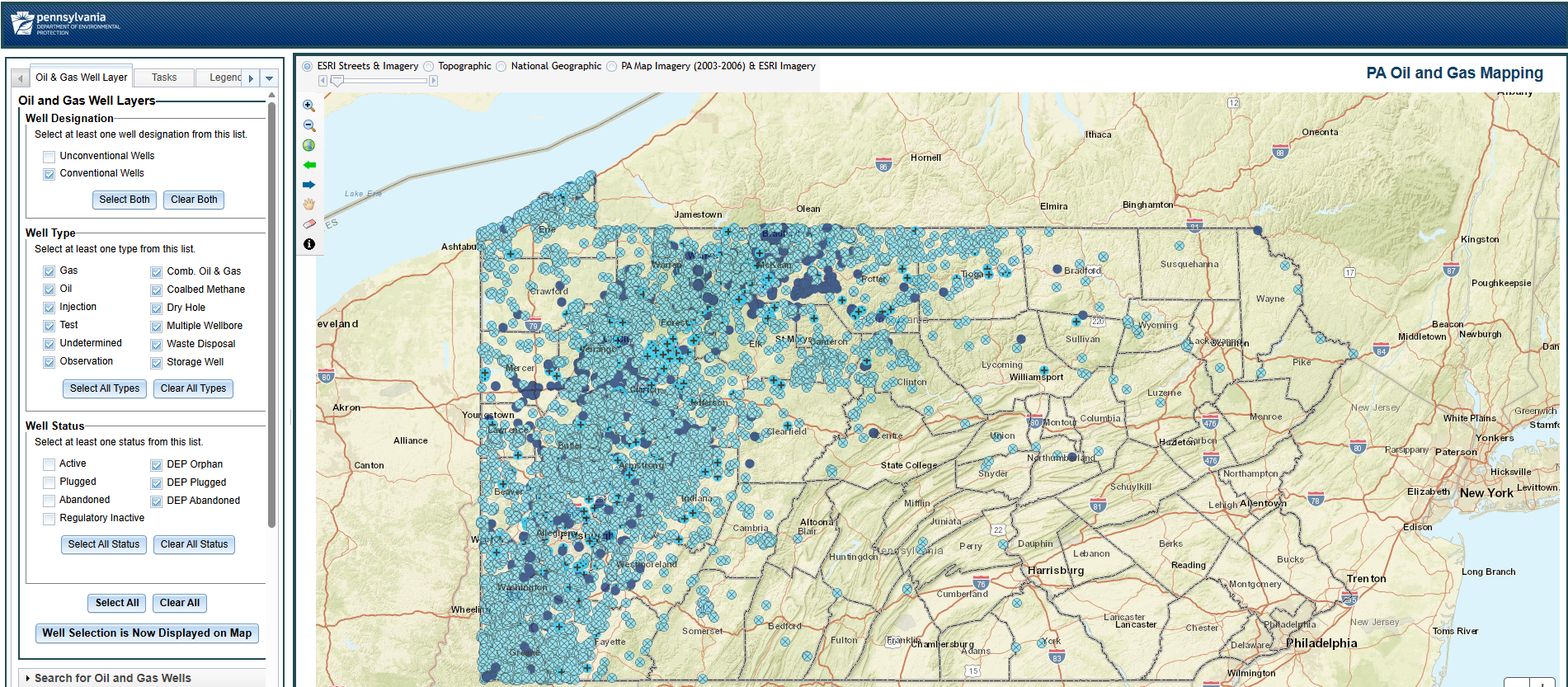
- To view abandoned, orphan, or plugged wells on the map, go to the “Oil and Gas Well Layer” tab (left side of page)
- Well Designation - select “Conventional Wells”
- Well Type – “Select All Types” button
- Well Status - select “DEP Orphan”, “DEP Abandoned”, and/or “DEP Plugged”
- Select “Submit Request” button
- Wells with the selected statuses will be displayed on the interactive map
- Select the “i” (information icon), then select any well on the map for well name, permit number, and additional information