


Elk Hunting Overview
Sign up to receive updates/information on Pennsylvania's elk herd. Emailed updates will be sent 3-4 times per year and cover topics such as elk hunting season results, annual population estimates, habitat enhancement activities, research updates and more.

Elk application sales for the 2026 season will open on May 1, 2026.
?ts=1733238164284&dpr=off)
NEW CHANGES In effect for 2026-27 season
Pennsylvania hunting license required - As of January 1, 2026, all elk license applicants, including non-residents, must possess a valid Pennsylvania general hunting license to apply.
Cap on licenses awarded to non-residents - As of January 1, 2026, no more than 10% of available elk licenses will be awarded to nonresidents. Residency status is determined at the time of application.
Antlered licenses are once in a lifetime - Beginning this year, applicants drawn for an antlered elk license will be ineligible to apply for an antlered elk license in the future. This change is not retroactive, meaning it only applies to applicants drawn starting in 2026 and in the future. Applicants may still apply for antlerless licenses.
Additional elk hunting season - A new early October firearms season segment has been approved, running from October 3-11, 2026. The season was added to create additional hunting opportunity and limit crowding across hunt zones.
New simplified elk license application - Applicants will now submit one elk license application. The application fee is $11.97. Applicants may select up to five combinations of their preferred season, sex, and hunt zone. There is no longer a fallback option. Applicants are highly encouraged to submit all five selections on their application to maximize their chance of being selected for a season in which they wish to participate.
- Consolidation of bonus points - Previously, bonus points have been divided into three separate categories, one for each elk hunting season. To simplify the application and accommodate the addition of the new season, points will be consolidated into a single pool of bonus points. No bonus points will be removed. If an applicant is drawn for a license, their bonus points will automatically reset to zero. If not drawn for a license, an applicant will receive one bonus point. Consolidated bonus point totals will be available in HuntFishPA by April 22, 2026.
Elk License Application Information

2026 Elk Application Period: May 1, 2026 to July 12, 2026
Apply Online: Visit HuntFishPA to apply for the elk license drawing and check the status of your application.
Pennsylvania Hunting License Required: All elk license applicants, including non-residents, must possess a valid Pennsylvania general hunting license before applying.
Applicant Options: Applicants will now submit one elk license application at a cost of $11.97 and may select up to five choices on that application.
Each choice includes:
- Season
- Management zone
- License type (antlered or antlerless)
No Fallback Option: There is no longer a fallback option. Applicants are strongly encouraged to use all five selections to maximize their chances of being selected for a season and zone in which they wish to participate.
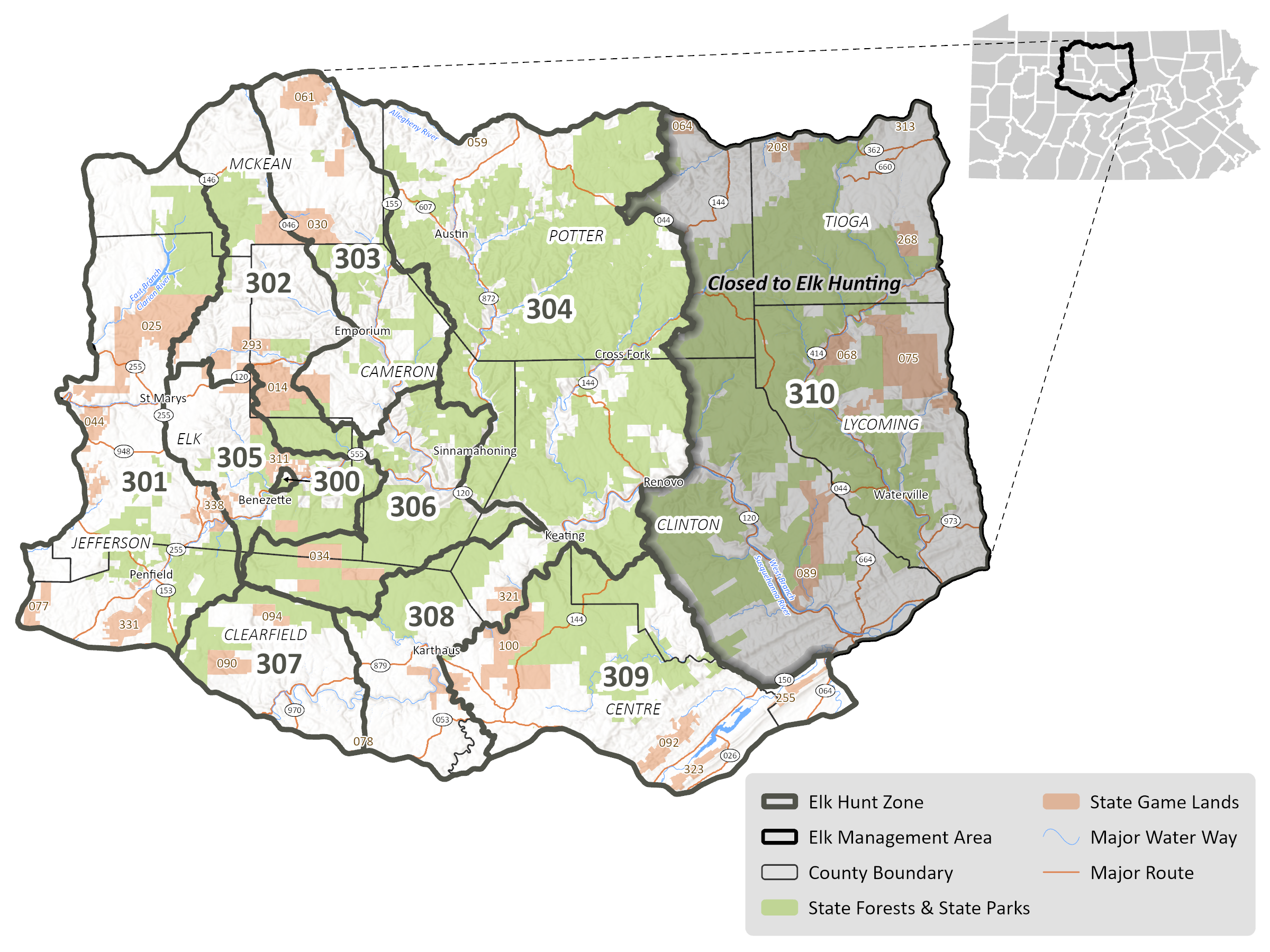
*Preliminarily Approved : New elk hunt zones will take effect for the 2026 elk hunting season.
Review the elk hunt zone descriptions to learn more about each area and help decide where to apply.
- Elk Hunt Zone Descriptions - Learn more about each hunt zone, including general area details and important information for applicants.
- Hunt Zone Legal Descriptions - View the official detailed boundary descriptions for each elk hunt zone.
View the zone map below to see the updated hunt zone boundaries.

Bonus points are now combined into one single pool for all elk seasons.
- Applicants who are not drawn for a license will receive 1 bonus point.
- Bonus points continue to accumulate each year an applicant is not drawn.
- Applicants who are drawn for a license will have their bonus points reset to 0.
Any bonus points earned previously will remain on the applicant’s account and will carry over into the new system.
- . Consolidated bonus point totals will be available in HuntFishPA by April 22, 2026.
The conclusion of the drawing where the selected applicants are announced will take place Saturday, July 25, 2026 during the Elk Expo at the Elk Country Visitor Center in Benezette. Successful applicants who provide a phone number or email will be notified promptly by those methods, others will receive notification by postal mail.
The 2026 Elk Check Station will be located at the Elk Country Visitor Center, 134 Homestead Dr., PA 15821, from 10 a.m. to 6 p.m.
- GPS coordinates are 41.3233 N and 78.3684 W.
- Cell coverage on the elk range is sparse.
- The check station is open to the public.
Results from the Elk Check Station (near real-time map)
All elk harvested must be brought to the check station within 24 hours of harvest. Weight (2nd Regular only) and several biological samples will be collected by Game Commission biologists.
Check station location and hours for each specific elk season are listed below.
Elk Season | Season Dates | Check Station Location | Hours |
|---|---|---|---|
Archery Season | Sept. 12–27, 2026 | Game Commission Maintenance Building, 3508 Winslow Hill Rd., Benezette, PA 15821 | 10 a.m. – 2 p.m. |
Regular Season – First | Oct. 3–11, 2026 | Game Commission Maintenance Building, 3508 Winslow Hill Rd., Benezette, PA 15821 | 10 a.m. – 2 p.m. |
Regular Season – Second | Oct. 31 – Nov. 8, 2026 | Elk Country Visitor Center, 950 Winslow Hill Rd., Benezette, PA 15821 | 9 a.m. – 4 p.m. |
Regular Season – Third | Jan. 9–17, 2027 | Game Commission Maintenance Building, 3508 Winslow Hill Rd., Benezette, PA 15821 | 10 a.m. – 2 p.m. |
Additional Information for the Second Regular Season: The Elk Country Visitor Center will be open daily from 8 a.m. until the check station closes at 4 p.m. A presentation on the history of elk in Pennsylvania will be offered every 30 minutes in the theater.
Check Station: Harvested elk need to be taken to the elk check station within 24 hours. The Elk Check Station is located at the Elk Country Visitor Center, 134 Homestead Dr., Benezette, PA 15821. GPS Coordinates are 41.3233 N and 78.3684 W. Cell coverage on the elk range is sparse. Elk Check Station (map) (PDF) Results from the Elk Check Station
Regulations: Please consult the current Pennsylvania Hunting & Trapping Digest for details about this year's elk hunt.
Elk are Large Animals: An adult bull may weigh 600-1,000 pounds and an adult cow may weigh 400-600 pounds. Part of your hunt plan should include how to field-dress and move the animal from the kill site to your vehicle and on to the check station. Regulations prohibit the use of motorized vehicles, including ATVs on state-owned property, with few exceptions. The animal may be skinned and quartered and packed out by horses or mules or on pack boards. Hunters should bring plenty of help. Any number of unlicensed persons may accompany hunters as long as they wear the required fluorescent orange and do not participate in the hunt itself or carry a firearm. Persons just accompanying an elk hunter are not required to have an elk guide permit.
Where can I get detailed information about individual elk hunt zone boundaries?
Hunters have successfully harvested elk in every hunt zone. Carefully examine each zone considering road access and the amount of available public and private land.
Archery Elk Shot Placement(video 2:44)
To check the status of an Elk License Application: Go to huntfish.pa.gov. Log into your account and scroll to the bottom left-hand corner under "Applications and Points", your Bonus Points awarded to date will be displayed. Click "Submitted Applications" to check the status of an application for the current license year.

Persons interested in becoming a guide for Pennsylvania elk hunters should contact the Special Permits Enforcement Division at 717-783-8164.
A Dream & A Draw
Hunt Elk in PA
Elk Frequently Asked Questions
Research and data collection are a fundamental part of elk management in Pennsylvania. Radio collars are specifically used to estimate three things: age specific survival, habitat use and population.
As of March 2023, the elk population is estimated between 1300-1400 animals,
This varies with geography. In Pennsylvania wild cow elk live and average of 10 years, while bulls live an average of 8 years. The oldest known cow in Pennsylvania was 32, and the oldest bull was 15. Captive elk live longer than wild elk.
Yes, bears and coyotes will prey on elk calves, but cow elk have a strong maternal instinct to protect their calves. People are the only predator of adult elk in Pennsylvania.
To some degree, nearly all Pennsylvania wildlife compete for resources. Elk are primarily grazers while deer are primarily browsers, however, elk will seasonally shift to a browse-based diet, particular in winter. The Game Commission and several partner organizations put a tremendous amount of time and effort into improving elk habitat, which inevitably benefits deer and other wildlife.
The elk rut is triggered by photoperiod (day length) and generally begins around the middle of September and carries through the early- to mid-October. If a cow is not bred in her first estrus cycle, she'll re-cycle approximately every 21 days providing up to three additional opportunities for conception.
Elk are crepuscular, moving more during dawn and dusk. So whether you're trying to view or hunt elk, you'll have more success if you go early in the morning or late afternoon/evening. The most popular time of year to observe elk is during the rut because they are very active.
Cow elk usually begin calving the last week of May through the first two weeks of June, with the peak around June 5th. Every year one or two newborn calves are seen later in the summer (July or August) and these animals are from cows that were bred after the peak of the rut (September).
At birth calves generally weigh between 33 and 45 pounds, with males being heavier than females. A calf's birth weight is correlated to the health of its mother, which is dependent upon the quantity and quality of the available habitat and seasonal variation in weather patterns.
Calves grow very quickly, and by late September they will lose their spots as their summer coats are replaced with winter coats.
Very rarely, twinning is possible but occurs in less than 1 percent of elk births. There is only one record of twins occurring in Pennsylvania and they were still-born.
Yes, many scientists believe that the teeth are remnants of tusks from prehistoric ancestors. They are also called buglers, whistlers and ivories.
Most bulls tend to lose their antlers right between March 10 and 25; there are always exceptions. Changes in photoperiod (day length) cause a reduction in testosterone that ultimately causes a bull's antlers to drop off.
Yes, collecting sheds from public lands (except National Parks) or land you own or have permission to be on is legal. However, it is not legal to pick up any parts or bones of an elk you found dead, including skulls and antlers.
Finding an elk shed is about 90 percent luck. There are a few tips that might improve your chances. First; think about where elk spend time when sheds are dropping. Elk home ranges shift seasonally, so searching for sheds where you've seen elk in the summer is generally a poor strategy. Second; go slow and try to develop an "eye" for sheds. Walk slowly through an area scanning back and forth and look for the white tips of the antler sticking up. Third; put your time in. The people that seem to find sheds every year are usually the ones that spend hours walking around the woods.